

A sore knee after a workout. A stiff shoulder after playing badminton. Pain in your elbow after lifting weights. A joint that feels uncomfortable every time you climb stairs.
Not every ache means you have a serious orthopaedic problem. Muscle soreness after unusual activity may settle with time, while minor strains can improve with rest and appropriate care. But pain that keeps returning, gets worse, limits movement, or starts affecting everyday activities deserves more attention.
So how do you know when it is time to see an orthopaedic doctor?
The answer depends on where the pain is, how it started, how long it has lasted, and whether you have other symptoms such as swelling, weakness, numbness, stiffness, or difficulty putting weight on a joint. Getting the cause assessed can help you understand whether you need simple recovery measures, rehabilitation, or more specialized orthopaedic treatment.
One of the first questions people ask is whether they should simply wait for the pain to go away. Muscle pain can happen after exercise, overuse, an unfamiliar activity, prolonged sitting, or a minor strain. Joint pain can also develop after an injury or repetitive movement. But there are many other possible causes, including arthritis, tendon problems, ligament injuries, cartilage problems, and other musculoskeletal conditions.
Is This Just Muscle Soreness or Something More?
The pattern matters. Pain that gradually improves while you return to normal movement may be less concerning than pain that continues for days, repeatedly comes back, or begins interfering with walking, working, exercising, or sleeping. If you are unsure why the pain is happening, it is better to have the cause assessed rather than assuming it is simply part of getting older or exercising regularly.
Why Does My Knee Hurt When I Walk or Climb Stairs?
Knee pain can have many different causes. An injury, overuse, tendon or ligament problems, cartilage changes, and arthritis can all contribute to knee symptoms. You may notice discomfort when climbing stairs, getting up after sitting, walking for longer distances, squatting, exercising, standing for extended periods, or putting weight on the affected leg.
Swelling, stiffness, instability, clicking, locking, or difficulty moving the knee can provide additional clues about what may be happening. If knee pain is persistent or starts changing the way you walk or perform everyday activities, an orthopaedic assessment can help identify the underlying problem. If you are searching for a Knee Care Specialist in Noida, the focus should be on understanding the cause of the pain instead of simply treating the symptom.
When Does Knee Pain Need More Specialized Attention?
Not every knee problem requires advanced treatment, but persistent symptoms should not be ignored. Pain that continues despite reducing activity, keeps returning during exercise, or affects your ability to walk comfortably may require a closer evaluation. Depending on the condition, treatment could involve activity modification, physiotherapy, medication, supportive measures, or other orthopaedic options.
For patients experiencing ongoing knee symptoms in the area, a Knee Pain Specialist in Sector 76 can assess the condition and determine whether the problem is related to an injury, joint changes, soft-tissue concerns, or another cause. The right treatment should be based on the actual diagnosis and the patient’s functional needs.
Why Does My Shoulder Hurt When I Raise My Arm?
Shoulder pain can be particularly frustrating because many everyday movements involve the shoulder. You may have difficulty raising your arm, reaching overhead, putting on clothes, carrying a bag, reaching behind your back, or sleeping comfortably on the affected side.
Shoulder symptoms can occur after an injury, repetitive activity, sports, weight training, or problems involving the muscles, tendons, or other structures around the joint. Persistent pain, weakness, restricted movement, or discomfort that interferes with sleep should not simply be ignored. An orthopaedic evaluation can help determine whether the problem is related to a muscle, tendon, joint, or another structure.
Why Does My Elbow Hurt When I Grip or Lift Something?
Elbow pain can develop after repetitive gripping, lifting, sports, weight training, or other activities that place repeated stress on the muscles and tendons around the joint. You might notice pain while lifting weights, carrying a bag, opening a jar, using tools, playing a sport, or repeatedly bending and straightening your arm.
Overuse injuries can affect the soft tissues around a joint, including tendons. If reducing the activity does not improve the pain, or if weakness and restricted movement develop, an assessment can help determine what is causing it. Continuing to repeatedly stress the painful area without understanding the cause may make recovery more difficult.
Could My Neck or Muscle Pain Be From My Daily Routine?
Sometimes the answer may be as simple as spending too long in one position. Long periods at a computer, extended phone use, an uncomfortable workstation, muscle tension, or an old injury can contribute to neck discomfort and stiffness. Similar problems can also develop in the back, shoulders, or other muscle groups because of poor posture and repetitive activity.
Occasional discomfort may improve with movement and rest, but persistent symptoms deserve attention. If pain is accompanied by significant weakness, numbness, restricted movement, or other concerning symptoms, medical assessment becomes particularly important. A Musculoskeletal Specialist Near Me can evaluate problems involving muscles, joints, bones, tendons, and ligaments and help determine the appropriate next step.
Does Joint Pain Mean I Have Arthritis?
Not necessarily. Arthritis is one possible cause of joint pain, but joint symptoms can also result from injuries, overuse, tendon problems, bursitis, gout, and other conditions. Arthritis can cause symptoms such as pain, stiffness, swelling, warmth, reduced movement, and difficulty with everyday activities.
This is why identifying the cause of joint pain is more useful than simply assuming that the pain is due to age. If joint discomfort continues or starts affecting your normal routine, a proper evaluation can help distinguish between different possible causes and guide appropriate treatment.
When Should You Consult a Joint Specialist?
You may want to arrange an orthopaedic evaluation if the pain keeps coming back, becomes progressively worse, causes persistent swelling or stiffness, limits your range of movement, or makes it difficult to walk or use the affected arm. Pain that interferes with sleep, work, exercise, or daily activities also deserves attention.
If symptoms began after a fall, accident, sports injury, or sudden movement, it is particularly important to understand whether there may be an underlying structural problem. Someone searching for a Joint Specialist Near Me should consider a specialist who can properly assess the joint and recommend treatment according to the actual condition.
When Does Joint Pain Need Urgent Medical Attention?
Some symptoms should not be treated as routine aches. Seek prompt medical attention if a joint becomes very painful, hot, swollen, or difficult to move, particularly when these symptoms appear suddenly or are accompanied by fever or feeling unwell.
After an injury, urgent assessment is also important if you cannot put weight on the affected joint, the joint appears out of position, you have severe pain or significant swelling, or you develop numbness or loss of sensation. These symptoms can occur with more significant injuries and may require timely evaluation.
Why Can Two People Have the Same Pain but Need Different Treatment?
Pain in the same body part does not necessarily mean the same condition. For example, knee pain in one person could be related to an injury, while another person’s symptoms may be associated with joint degeneration. Shoulder pain could involve a tendon problem in one person and an injury or stiffness in another.
This is why treatment should not be based only on where the pain occurs. An orthopaedic assessment may include questions about when the pain started, whether there was an injury, what movements make it worse, whether the pain comes and goes, and whether you have symptoms such as swelling, stiffness, weakness, or numbness.
Depending on the findings, your doctor may recommend further examination, imaging, physiotherapy, medication, injections, or another form of treatment.
Do All Joint Problems Need Surgery?
No. Surgery is only one possible treatment, and whether it is appropriate depends on the specific condition, severity, symptoms, and response to other treatments. Many musculoskeletal problems can initially be managed with non-surgical approaches when appropriate.
Depending on the diagnosis, orthopaedic care may include:
- Activity modification
- Physiotherapy
- Targeted exercises
- Medicines when appropriate
- Supportive devices
- Injections in selected cases
- Surgical treatment when indicated
For patients with significant joint damage, a Joint Replacement Surgeon in Sector 73 may evaluate whether joint replacement or another treatment option is appropriate. The decision should always be based on the patient’s condition rather than the location of the pain alone.
When Is Knee Replacement Considered?
Knee replacement is not usually the first treatment for every person with knee pain. It may be considered in patients with significant joint damage and persistent symptoms when other appropriate treatments have not provided sufficient relief and daily activities are being affected.
If someone is searching for a Knee Replacement Doctor in Sector 74, the important first step is a detailed evaluation. The doctor needs to understand the severity of the joint problem, symptoms, mobility, activity limitations, and previous treatment before deciding whether replacement surgery is appropriate.
What About Hip Pain and Hip Replacement?
Hip pain can affect walking, climbing stairs, getting up from a chair, exercising, and other everyday activities. Depending on the cause, treatment may range from activity modification and physiotherapy to more advanced orthopaedic procedures.
Patients with advanced hip joint problems may require an assessment from a Hip Replacement Specialist in Sector 75. However, hip replacement is considered only when the condition and symptoms indicate that it may provide meaningful improvement. A proper evaluation is important before making such a decision.
Can Robotic Knee Surgery Be an Option?
Advances in orthopaedic technology have introduced robotic assistance into certain knee replacement procedures. Robotic systems can assist surgeons with planning and execution during selected procedures, but they are not automatically required for every patient with knee pain or every knee replacement.
If you are searching for Robotic Knee Surgery in Sector 78, the first question should still be whether knee replacement is actually appropriate for your condition. The decision depends on the diagnosis, extent of joint damage, symptoms, overall health, and suitability for the procedure.
What About Sports Injuries and Joint Problems?
Active people can experience joint, muscle, ligament, tendon, and bone injuries during running, gym workouts, badminton, football, or other physical activities. Some injuries improve with appropriate early care, while others require specialist evaluation and rehabilitation.
For someone searching for a Sports Injury Specialist in Sector 50, an important part of treatment is identifying the structure involved and understanding the demands of the person’s activity. The aim is not simply to reduce pain but to restore movement, strength, stability, and function before returning to demanding physical activity.
Can Plaster or Support Be Used for Orthopaedic Injuries?
Some fractures and injuries require immobilization to protect the affected area while healing begins. Depending on the injury, a doctor may recommend plaster, a cast, a brace, or another form of support. The appropriate option depends on the location and nature of the injury.
People sometimes search for light weight plaster in Noida or Water proof plaster near me because they want more comfort and convenience during recovery. However, the type of plaster or support should be selected according to the medical requirements of the injury. Comfort is useful, but proper stabilization and healing remain the priority.
Could PRP Treatment Help Certain Joint or Soft-Tissue Problems?
PRP, or platelet-rich plasma treatment, may be considered for selected musculoskeletal and soft-tissue conditions. It uses a concentrated portion of the patient’s own blood components and is administered to the affected area. However, PRP is not suitable for every type of pain and should not be considered a universal treatment.
If you are searching for PRP Treatment Near Me, the first step should be understanding what is actually causing the symptoms. A proper clinical assessment can help determine whether PRP or another treatment approach may be appropriate for the particular condition.
What Can I Do Before Seeing an Orthopaedic Doctor?
If your pain is mild and there are no warning signs, some basic measures may help while you monitor your symptoms. Depending on the type of problem, these may include temporarily reducing activities that clearly worsen the pain, maintaining comfortable movement, and using cold or heat appropriately when advised.
For a recent injury, protecting the affected area and avoiding activities that increase pain may be helpful. However, persistent or worsening symptoms should be evaluated rather than repeatedly managed at home. Do not assume that every type of joint or muscle pain should be treated in exactly the same way.
What Should You Tell Your Orthopaedic Doctor?
You do not need to have a diagnosis before your appointment. However, a few details can make the consultation more useful. Try to remember when the pain started, whether it began after an injury or activity, whether it is constant or comes and goes, which movements make it worse, and whether you have swelling, stiffness, numbness, or weakness.
It is also useful to mention whether you have experienced the same problem before and what you have already tried for relief. These details can help your doctor understand the pattern of your symptoms and decide whether further examination or investigation is required.
Where Can You Seek Orthopaedic Care in Noida?
People looking for orthopaedic care may come from different parts of Noida, including Sector 75, Sector 72, Sector 76, Sector 73, Sector 77, and Sector 50. Patients from these areas may seek consultation for sports injuries, fractures, knee pain, joint problems, muscle conditions, and other musculoskeletal concerns.
A Best Orthopedic Center in Sector 75 should focus on proper diagnosis, suitable treatment options, follow-up, and rehabilitation rather than using the same treatment for every patient. If you are searching for the Best Orthopedic Doctor Near Me or Best Orthopedic Specialist Near Me, look for professional assessment and clear guidance about your condition and recovery.
When Should You See an Orthopaedic Doctor?
If your joint or muscle pain keeps returning, limits your movement, follows an injury, or begins interfering with everyday life, an orthopaedic consultation can help determine what is actually causing it.
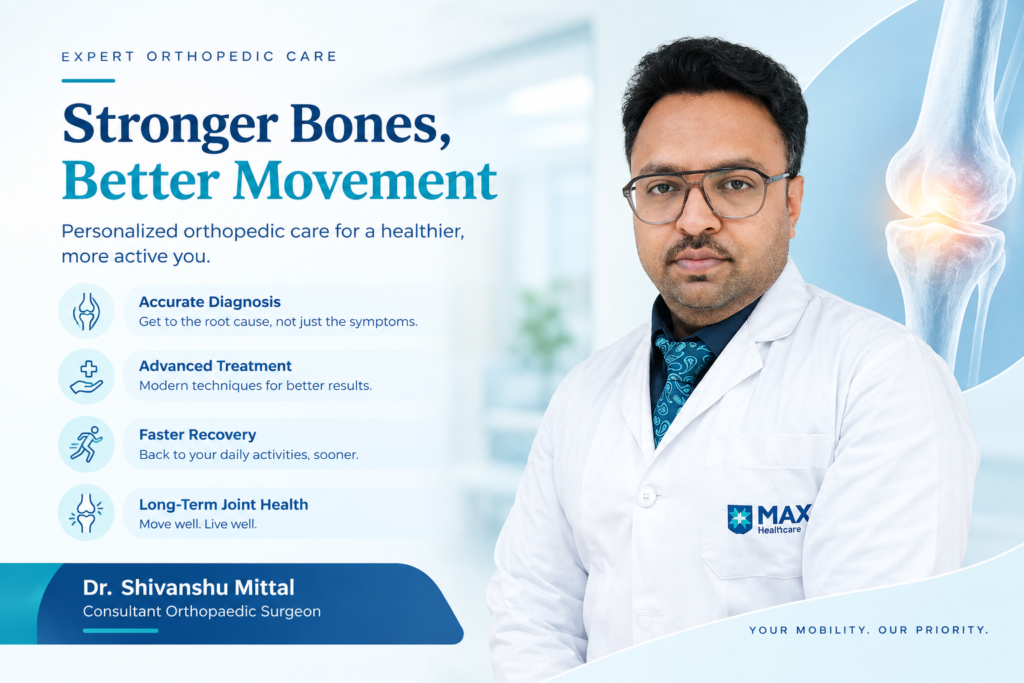
Dr. Shivanshu Mittal provides orthopaedic consultation and care for conditions involving joints, bones, muscles, ligaments, and other parts of the musculoskeletal system. Depending on the condition, treatment may involve conservative care, rehabilitation, sports injury management, fracture care, or surgical options when clinically appropriate.
For patients searching for an Orthopedic Doctor Near Me, the goal should not simply be to find someone who treats pain. The more important step is finding the underlying cause and choosing a treatment plan that matches the patient’s condition, activity level, and recovery needs.
Don’t Ignore Pain That Keeps Changing Your Routine
An occasional ache after an unfamiliar activity is not necessarily a reason for concern. But pain that keeps returning, gradually worsens, limits movement, or interferes with sleep, work, exercise, or walking deserves a closer look.
Whether you are dealing with knee pain, shoulder pain, elbow pain, muscle discomfort, sports injuries, or recurring joint problems, the goal should not simply be to keep masking the pain. Finding the underlying cause can help you understand what your body needs and what treatment options may be appropriate.
The important questions are simple: Is the pain improving? Can you move normally? Can you walk or exercise comfortably? Does the pain return whenever you become active? If the answers suggest that the problem is not settling as expected, it may be time to get it checked.
Frequently Asked Questions
1. When should I see an orthopaedic doctor for joint pain?
Consider an orthopaedic evaluation if pain persists, keeps returning, limits movement, follows an injury, or starts interfering with normal activities, exercise, work, or sleep.
2. Is joint pain a normal part of ageing?
Joint problems can become more common with age, but persistent pain should not automatically be dismissed as ageing. Arthritis is one possible cause among several conditions that can produce joint pain.
3. Can exercise cause knee or muscle pain?
Yes. Repetitive activity, overuse, sudden changes in activity, poor technique, or an injury can contribute to muscle, tendon, ligament, and joint problems.
4. Does every joint problem require surgery?
No. Depending on the diagnosis, treatment may include activity modification, physiotherapy, exercise, medication, supportive measures, injections, or surgery when necessary.
5. Can PRP treatment be used for every joint problem?
No. PRP may be considered for selected musculoskeletal and soft-tissue conditions, but it is not appropriate for every type of pain. A proper diagnosis is important before deciding whether it may be useful.
6. When is joint pain an emergency?
Severe pain after an injury, inability to put weight on a joint, a joint that appears out of position, or numbness or loss of sensation after an injury requires urgent medical attention. A hot, swollen, painful joint accompanied by fever or feeling unwell also needs prompt assessment.