

You twist your ankle while running.
Or maybe your knee starts hurting after a workout. You pull a muscle at the gym. Your shoulder hurts after playing badminton. At first, you think:
“It will probably get better in a few days.”
Sometimes it does.
But what if the pain is still there a week later? What if your knee feels unstable when you walk? Or you can move normally, but the moment you try to exercise again, the pain comes back?
That is when a sports injury deserves more attention.
“Is This Just Muscle Soreness, or Did I Actually Injure Myself?”
Sports injuries can affect professional athletes, regular gym-goers, runners and anyone who enjoys recreational physical activity. They can involve muscles, tendons, ligaments, cartilage, joints, or bones, and the right treatment depends on what has actually been injured.
This is often the first question people have after exercise.
Normal post-workout soreness usually settles with time. An injury may feel different. You might notice swelling, bruising, sharp pain, stiffness, weakness, or difficulty using the affected body part.
Sports injuries can happen suddenly, such as when you:
- Twist your ankle
- Land awkwardly after a jump
- Fall during a game
- Collide with another player
- Suddenly change direction
- Lift something incorrectly
They can also develop slowly.
Repeated stress on the same muscle, tendon, joint, or bone can eventually cause an overuse injury. Increasing your workout intensity too quickly or continuing to exercise despite persistent pain can make the problem harder to manage.
So if your body keeps telling you something is wrong, it is worth listening.
“What Are the Most Common Sports Injuries?”
There is no single type of sports injury.
The injury often depends on the sport, movement, and part of the body involved.
Common examples include:
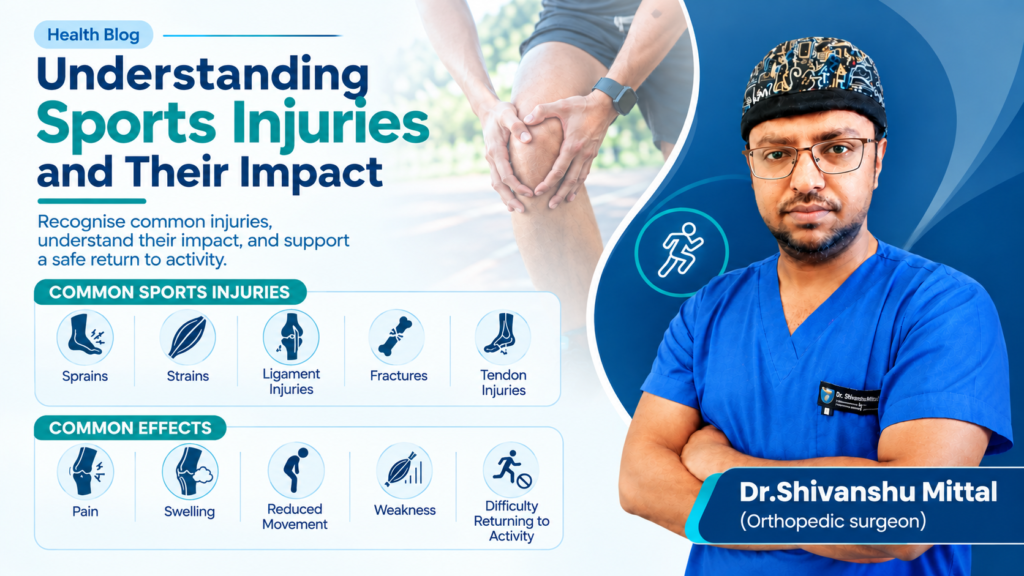
- Ankle sprains: Often occur after twisting or rolling the ankle.
- Muscle strains: Can affect muscles or the tendons connecting them.
- Knee injuries: May involve ligaments, cartilage or the meniscus.
- Shoulder injuries: Can occur with repetitive overhead movements or falls.
- Ligament injuries: May happen when a joint is forced beyond its normal movement.
- Tendon injuries: Can develop from repeated loading or sudden force.
- Overuse injuries: Develop gradually when tissues are repeatedly stressed without enough recovery.
- Fractures: Can occur after significant impact or, in some situations, repetitive stress.
The important thing is that pain location does not always tell you exactly what is injured.
For example, knee pain could involve several different structures. That is why an examination may be needed when pain persists or movement becomes difficult.
“What Should I Do Immediately After a Sports Injury?”
Your first instinct may be to stretch the painful area or try to “walk it off.”
That is not always a good idea.
If an activity clearly caused pain, stop the activity and protect the injured area from further stress.
For a minor sprain or strain, early care may include relative rest, cold application, compression and elevation to help manage pain and swelling. Cold should not be applied directly to the skin.
You do not necessarily need complete bed rest for every minor injury. As symptoms improve, appropriate movement may be introduced gradually.
But there are situations where home care is not enough.
Severe pain, significant swelling, visible deformity or an inability to bear weight should prompt medical evaluation.
“My Pain Isn’t Going Away. Do I Need an Orthopaedic Doctor?”
If the pain keeps coming back, interferes with exercise or affects normal movement, it is worth getting it assessed.
Why?
Because sports-related pain is not always a simple muscle strain.
An orthopaedic evaluation can help determine:
- How the injury happened
- Which movement causes pain
- Whether there is swelling
- Whether the joint is unstable
- Whether strength has decreased
- Whether your range of movement is restricted
- Whether further investigation is needed
Depending on the suspected injury, your doctor may recommend imaging such as an X-ray or other investigations. This can be particularly relevant when there is concern about a fracture, ligament injury, cartilage damage or another structural problem.
If you are searching for an Orthopedic Doctor in Noida, the goal should not simply be to find someone who treats sports injuries. You want the injury to be properly assessed so that your recovery plan matches the actual problem.
“Do All Sports Injuries Need Surgery?”
No.
The treatment depends on what is injured, how severe the injury is and how well the affected area is functioning.
Some minor injuries may improve with activity modification, pain management and rehabilitation.
Others may require:
- Bracing or support
- Physiotherapy
- Structured strengthening
- Mobility exercises
- Balance training
- Sport-specific rehabilitation
- Further medical treatment
- Surgery in selected cases
For example, a minor ankle sprain may be managed conservatively, while a significant ligament injury may require a more detailed treatment plan.
The aim is not simply to make the pain disappear.
The bigger goal is to restore movement, strength, stability and function so you can safely return to activity.
“Why Do I Still Feel Weak Even Though the Pain Is Better?”
This is something many active people overlook.
You may feel almost normal during everyday activities and assume you are ready to return to your sport.
But pain improving does not necessarily mean your strength, balance, flexibility or coordination have completely recovered.
That is where rehabilitation becomes important.
Depending on the injury, rehabilitation may include:
- Restoring comfortable movement
- Improving flexibility
- Rebuilding strength
- Improving balance and stability
- Gradually increasing physical activity
- Practising movements specific to your sport
For example, rehabilitation after a knee injury may focus on the muscles supporting the knee, while ankle rehabilitation may include balance and stability work.
A structured rehabilitation programme can help you progress based on your recovery rather than simply counting the number of days since the injury.
“When Can I Start Playing Again?”
This is probably the question every athlete wants answered.
“When can I get back on the field?”
The answer depends on the injury.
Returning just because the pain has reduced can sometimes be premature. You may still have weakness, restricted movement or poor stability.
A gradual return may mean progressing from:
Everyday movement → light activity → controlled exercise → sport-specific drills → full participation
The exact progression depends on the injury and your recovery.
If you are recovering from a concussion, for example, return to sport requires a specific, medically supervised progression. CDC guidance recommends that athletes with suspected concussion be removed from sports and only return after evaluation and clearance from a healthcare provider.
For other injuries, your doctor or physiotherapist can assess whether your strength, movement and function are sufficient for the demands of your sport.
“What If the Pain Comes Back When I Start Exercising?”
Don’t simply push through it.
If pain returns when you increase activity, it may mean that the injured area is not ready for that level of physical demand.
You may need to step back to a lower level of activity and reassess your recovery.
This is particularly important if the pain is accompanied by swelling, weakness, instability or restricted movement.
Your recovery should progress according to how your body is responding, not according to a deadline you have set for yourself.
“How Can I Prevent Sports Injuries in the First Place?”
You cannot prevent every sports injury.
But you can reduce some avoidable risks by preparing properly and giving your body enough time to adapt.
Simple habits include:
- Warm up before demanding activity
- Use appropriate footwear and protective equipment
- Increase training intensity gradually
- Give your body adequate recovery time
- Maintain strength and flexibility
- Use proper technique
- Pay attention to recurring pain
- Continue recommended strengthening after an injury
Protective equipment and sport-specific safety measures are also important, particularly in activities where falls or impacts are possible.
The key is not to wait until you are injured to start thinking about recovery and prevention.
“Which Sports Injury Symptoms Should Not Be Ignored?”
Not every sports injury needs immediate specialist care.
But some symptoms should make you stop and seek medical evaluation.
These include:
- Severe or increasing pain
- Significant swelling
- Inability to put weight on the affected limb
- Visible deformity
- Numbness
- Major stiffness
- Joint instability
- Significant weakness
- Pain that continues without expected improvement
- Difficulty returning to normal movement or activity
These symptoms may indicate that the injury needs more than home care.
And if there has been a head injury with possible concussion symptoms, do not try to assess the severity yourself. The CDC recommends removing the athlete from play and having them evaluated by a healthcare professional.
“How Do I Know Which Sports Injury Treatment I Need?”
You do not have to figure that out before seeing a doctor.
Your treatment plan should be based on:
- The type of injury
- The structure involved
- Severity
- Your symptoms
- Your physical examination
- Your activity level
- Your recovery progress
- The demands of your sport
A recreational runner and a competitive athlete may have the same injury but very different functional goals.
That is why personalised rehabilitation can matter just as much as the initial treatment.
Orthopaedic Care for Sports Injuries in Noida
If an injury is affecting your ability to exercise, play sports or move normally, getting the problem assessed can help you understand what is actually happening and what recovery may involve.
Dr. Shivanshu Mittal is described in the provided draft as an orthopaedic and joint replacement surgeon in Noida, with qualifications including MBBS, MS Orthopaedics and DNB Orthopedics/Orthopedic Surgery. His listed clinical areas include orthopaedic care, fracture and trauma management, joint replacement, arthroscopy and sports-injury management.
Someone searching for a Sports Injury Doctor in Noida or an Orthopedic Specialist Near Me may consider an evaluation when pain, swelling, instability or restricted movement continues after physical activity.
The provided draft also identifies patients from Sector 72, Sector 73, Sector 75, Sector 76 and Sector 50 Noida as part of the consultation area.
You Don’t Have to Play Through the Pain
Being active is good for your health, but pain should not always be treated as something you simply have to tolerate.
A minor injury may improve with appropriate early care and gradual rehabilitation. A more significant injury may need professional assessment and a structured recovery plan.
The important questions are simple:
What happened?
What hurts?
Is the pain improving?
Can I move normally?
Can I put weight on it?
Does the pain return when I exercise?
If the answers suggest that the injury is not settling as expected, it may be time to get it checked.
The goal is not just to get back to your sport quickly.
It is to get back safely and give your body the best opportunity to recover properly.
Frequently Asked Questions
What are the most common sports injuries?
Common sports injuries include sprains, muscle strains, ligament and tendon injuries, joint injuries, fractures and overuse-related problems. The type of injury depends on the activity and the forces placed on the body.
When should I see a doctor for a sports injury?
Consider medical evaluation if you have severe pain, significant swelling, difficulty bearing weight, visible deformity, numbness, instability or pain that is not improving as expected.
How long does a sports injury take to heal?
There is no single recovery timeline. Minor soft-tissue injuries may improve relatively quickly, while significant ligament, tendon, muscle or bone injuries can take longer and may require rehabilitation.
Is physiotherapy useful after a sports injury?
It can be. Physiotherapy may help restore movement, strength, flexibility, balance and function, depending on the injury and stage of recovery.
Can I return to sports as soon as the pain stops?
Not necessarily. Pain relief does not always mean that strength, movement, stability and sport-specific function have fully returned. A gradual return based on recovery is generally more appropriate than rushing back.