

Kishore B Reddy, VS Abhilash Kumar, Harinath Bellamkonda, Raghuveer Reddy D, Sai Krishna CS, Balaraju Naidu and Shivanshu Mittal
Unit of Musculoskeletal Oncology and Pelvic Reconstructive surgery, OMNI Hospital and American Oncology Institute, India
Abstract
Background: Some cases of bone sarcomas require complete resection of the femur to achieve adequate tumor-free margins. Total femoral endoprosthetic reconstruction is a salvage procedure. It restores femoral integrity and allows early rehabilitation owing to immediate fixation. The function achieved is far superior when compared to hip disarticulation. We present our experience with reconstruction in such cases using a total femoral prosthesis (TFP). Only a few such case series have been published in the literature.
Materials and Methods: 12 patients (8 males and 4 females) with a mean age of 25 years (10-68 years), operated on between 2010 and 2016, had a total femoral modular megaprothesis implanted. The diagnosis included osteogenic sarcoma (7), Ewing’s sarcoma (2), chondrosarcoma (1), malignant fibrous histiocytoma (1), and metastasis from renal cell carcinoma (RCC) (1).
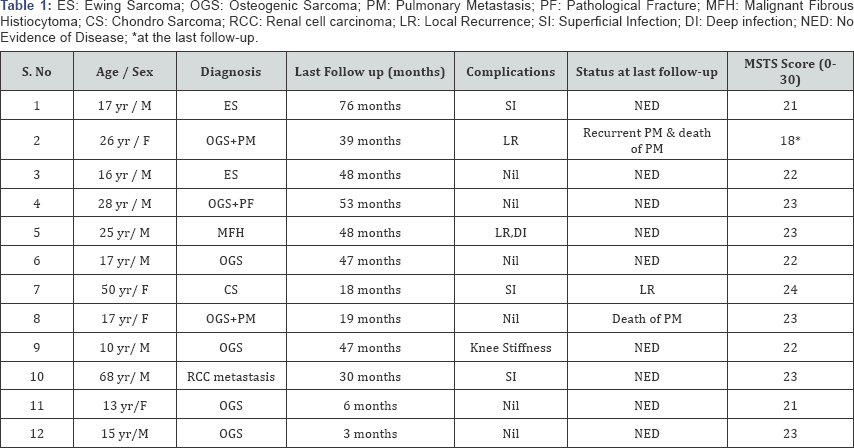
Results: After a mean follow-up of 36.1 months (min. 3 months and max. 76 months), functional outcome was assessed using the modified rating system of the Musculoskeletal Tumour Society score, the average of which was 21.9 (73%) (Table 1). Nine patients had no evidence of disease up to the last follow-up. Two patients had pulmonary metastasis, and three patients had local recurrence.
Conclusion: Total femoral endoprosthetic reconstruction is a reliable means of restoring anatomic, oncological, and functional results after complete femoral resection and a viable alternative to the mutilating procedures like hip disarticulation.
Introduction
The femur is a common site for primary bone sarcomas. Around 16% of Ewing’s sarcomas, 13% of chondrosarcomas, and 10% of osteosarcomas develop at this anatomic site. Such sarcomas involving the whole or a major part of the femur or those with skip lesions provide only two options – either hip disarticulation or limb salvage surgery. The limb salvage surgery presents a potential challenge. It involves removal of the entire femur along with the reconstruction of hip and knee joints. It also disrupts the hip abductors. When compared to hip disarticulation, limb salvage surgery is cost-effective and provides a more effective gait. The advent of newer chemotherapy regimens has increased the frequency of limb salvage procedures. The outcome of such procedures in the lower extremity, which allows for weight-bearing and useful ambulation, has been remarkable. Total femoral replacement is the most extreme salvage technique to serve the purpose. Options for reconstruction following extensive resections include total femoral prostheses (TFP), allografts, and rotationplasty. The use of TFR has increased worldwide owing to its use in revision arthroplasty. We here present our experience of 12 cases of total femoral prosthesis used as a salvage and reconstructive procedure in malignant conditions.
Materials and Methods
Between 2010 and 2016, 12 patients (8 males and 4 females), within the age range from 10 to 68 years (mean age 25 years) with malignant bone tumours involving part of or the entire femur, underwent reconstruction using a total femoral modular megaprothesis. The most common diagnosis was osteosarcoma (7 cases). The other diagnoses in our study were Ewing sarcoma (2), RCC metastasis (1), malignant fibrous histiocytoma (1) and chondrosarcoma (1). All patients underwent standard radiographic evaluation for staging (MRI and PET-CT whole body). Their disease was staged using Enneking’s system. All patients were in stage II except 2 patients who presented with pulmonary metastasis (stage III). The diagnosis was confirmed by needle biopsy in all patients. Preop chemotherapy was given in all cases of osteosarcoma and Ewing’s sarcoma.
Prostheses
ADLER implants with fixed hinges and metallic bipolar heads were used in all cases, made of 316 L stainless steel except for two where titanium implants were used.
Surgical Technique
Resection was done by wide excision with margins free of tumour confirmed by biopsy in all cases. An anterolateral approach was used in all the cases. The vastus intermedius muscle was sacrificed, and the sciatic nerve (and its branches) was preserved in all. A sleeve of the vastus lateralis and the rectus femoris were preserved to aid in hip flexion in all cases except one (where the rectus was involved in the biopsy scar). The capsule of the hip was preserved and repaired. Prolene mesh was used in cases where the capsule couldn’t be preserved. The proximal tibial cut followed by tibial component implantation was done with PMMA. The remaining vasti were sutured to the iliotibial band. The abductors were sutured to the prostheses. No additional procedures were done in any of the cases. The patients were evaluated every 6 weeks for the first two visits, every 3 months in the first 2 years and biannually till 5 years. The functional and oncological outcomes were assessed at every visit with physical and radiological examinations (X-ray). The mean follow-up is 36.1 months (min. 3 months and max. 76 months follow-up).
Postoperative Rehabilitation
Full weight bearing was started from the second postoperative day. A walker was used for the first two weeks. The limb was maintained in abduction while recumbent to allow the healing of abductors. Quadriceps strengthening was started from the 2nd postoperative day, and abductor strengthening was started after 6 weeks. A knee immobilizer was used in one patient as a major part of the quadriceps was removed. Patients were advised to avoid movements such as squatting and sitting cross-legged for a lifetime.
Functional Outcome
Functional outcome was assessed using the modified rating system of the Musculoskeletal Tumor Society core, the average of which was 21.9 (73%). No limb length discrepancy was observed.
Complications
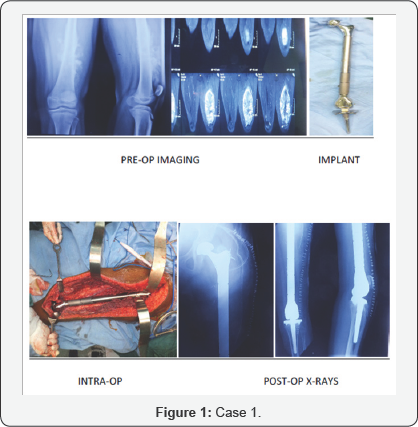
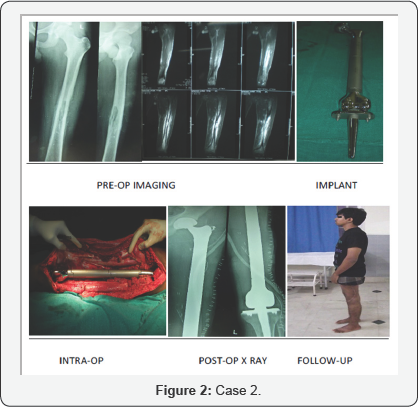
Three patients had superficial infections, which were resolved with wound debridement and IV antibiotics. No hip dislocation observed. There were no mechanical complications in our study, such as loosening of the tibial component, patella maltracking, and limb length discrepancy. No prosthetic revision was done. Three patients had local recurrence. One patient had a local recurrence at 18 months post-surgery and was advised to have surgery but lost follow-up. Another patient with local recurrence at 12 months post-surgery was treated with local excision and localised radiotherapy. He developed wound dehiscence and then deep infection and was subsequently managed with debridement and biodegradable antibiotic-loaded bone cement beads without implant removal. Another patient developed local recurrence 3 times following local excisions and was subsequently treated with hip disarticulation. She died 39 months post-surgery due to pulmonary metastasis. Another patient died of pulmonary metastasis at 19 months post-surgery (Figures 1 & 2).
Discussion
Buchanan was the first to perform a total femur replacement in 1952 and reported a second case in 1965, using a custom-made 1952 vitallium endoprosthesis, with a good functional result at 6 months. Most patients with sarcomas of the femur extending through a major part or the whole of it had an amputation done in the past, which resulted in poor functional outcomes. The use of improvised imaging and surgical techniques, newer and effective chemotherapy regimens, and advances in prosthesis design and biomaterials have all played a part in increasing the use and outcome of limb salvage surgery. It, however, should not compromise the survival of the patient while ensuring near-normal function as soon as possible [10, 11]. While the indications for a total femoral prosthesis are extremely limited and highly individual, there is an increase in the number of patients in whom such a prosthesis might offer an alternative to amputation (hip disarticulation). Total femoral replacement is mandatory in skip lesions or when there is a massive intramedullary extension if limb salvage is planned. Osteoarticular allograft replacement has disadvantages:
i. Delayed weight-bearing for at least one year until revascularization of the graft;
ii. Degeneration of articular cartilage; and
iii. Frequent recurrence of the fracture on weight-bearing.
Allo-prosthetic composites have disadvantages of increased infection and nonunion (3.7-11%). Breakage of prosthesis was not encountered in our study, compared to other reports that quote as high as 1-4%. As expected, there is a certain limitation of movement at the hip and knee and some amount of limp due to abductor insufficiency. Advantages of this method are an early functional recovery rate with a 70% MSTS score reported in a study by T. W. R. Briggs et al., a relatively low complication rate and a high level of emotional acceptance. The knee functions well postoperatively, while the bipolar hip is easier to insert and more stable than a conventional acetabular cup.
Conclusion
This study presents the total femoral modular mega prosthesis as a viable option for limb reconstruction with reasonable good function of the limb. The success of this type of surgery depends on careful patient selection, meticulous surgical technique and better prosthetic design performed in a special centre. We conclude that, in selected cases, the total femoral prosthesis offers a realistic alternative to the mutilating procedure of amputation (hip disarticulation).